
This is a Place holder generated by AI!
Demystifying Credit Scoring: A Beginner’s Guide
Have you ever wondered how banks decide whether to give someone a loan or a credit card? It is not magic, and it is not a guessing game. It all comes down to a three-digit number known as a credit score.
If you are just starting to learn about personal finance, credit scoring can feel like a secret club with confusing rules. But do not worry, understanding the basics is much simpler than it seems.
What Exactly is a Credit Score?
Think of a credit score as your financial GPA. Just like your grades in school show teachers how well you perform academically, your credit score shows lenders (like banks or credit card companies) how reliably you manage borrowed money.
When you apply for a loan, a credit card, or even try to rent an apartment, the person on the other end wants to know: If I let this person borrow money, how likely are they to pay it back on time? Your credit score gives them a quick, mathematical answer.
The Ingredients of a Credit Score
You do not start with a credit score automatically. It is built over time based on your financial habits. While different models exist, most standard credit scoring systems (like the FICO score) look at five main ingredients:
-
Payment History: This is the most crucial factor. Do you pay your bills on time? Even a few late payments can significantly lower your score.
-
Amounts Owed (Credit Utilization): This looks at how much of your available credit you are actually using. If you have a credit card with a $1,000 limit and you consistently spend $900 of it, lenders might think you are overextending yourself.
-
Length of Credit History: How long have you been using credit? A longer history of good behavior proves to lenders that you are consistently responsible over time.
-
New Credit: If you apply for several new credit cards or loans in a very short period, it can make you look risky or desperate for cash to a lender.
-
Credit Mix: Lenders like to see that you can successfully handle different types of credit at the same time, such as a credit card (revolving credit) and a student loan (installment credit).
Understanding the Numbers
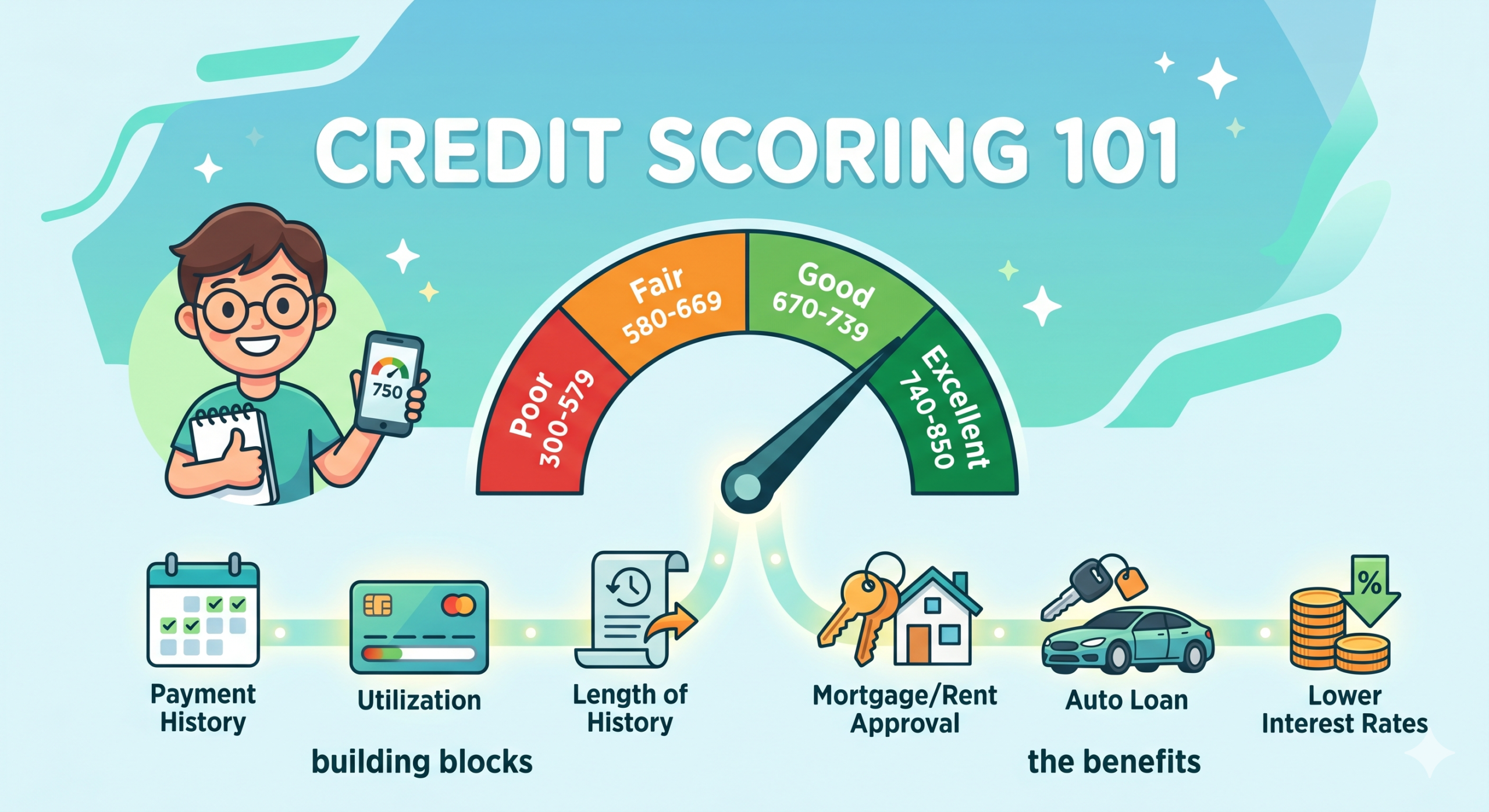
Credit scores typically range from 300 to 850. The higher your number, the better your financial reputation. Here is a general breakdown of what those numbers mean to a lender:
| Score Range | Category | What it Means for You |
| 300 – 579 | Poor | Hard to get approved for loans; very high interest rates if approved. |
| 580 – 669 | Fair | May get approved, but will likely still face higher interest rates. |
| 670 – 739 | Good | Generally good approval odds and standard, competitive interest rates. |
| 740 – 799 | Very Good | High likelihood of approval with better-than-average rates. |
| 800 – 850 | Excellent | Easy approvals and the lowest, most favorable interest rates available. |
Why Does Your Score Matter?
A good credit score saves you money. When you have a high score, banks trust you, so they charge you lower interest rates to borrow money. Over the course of buying a car or a house, a great credit score can literally save you tens of thousands of dollars. It can also make it much easier to get a preferred cell phone plan, set up utilities without needing to put down a cash deposit, and secure a lease on a nice apartment.
Building a great score takes time, discipline, and patience, but understanding how the game is played is the first and most important step.
Would you like to explore some practical tips on how to start building your very first credit score from scratch?
Get in touch
Send us an email if you would like to discuss this topic in more detail or explore ways CRS can support your organisation – info@credit-risk-solutions.com